







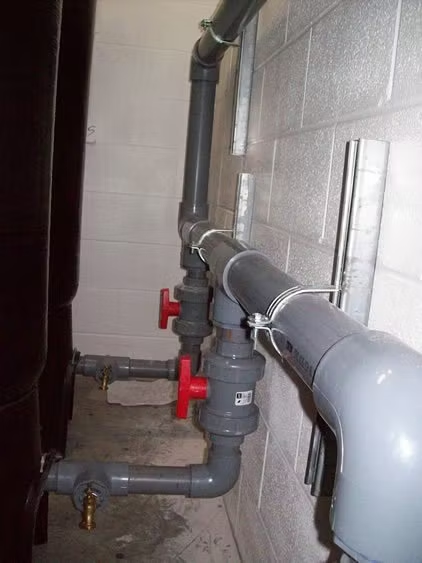
TAC Technology for Multi-family Buildings – Complete Guide to Template Assisted Crystallization (TAC) Alternative to Water Softeners
TAC Technology for Multi-family Buildings – Complete Guide to Template Assisted Crystallization (TAC)
What is TAC technology and why is it becoming increasingly common in apartment buildings?
TAC technology, or Template Assisted Crystallization, has quickly become one of the most interesting solutions for water treatment in apartment buildings. Property owners, condominium associations and technical managers are currently looking for energy-efficient and sustainable alternatives to traditional water softeners. Here, TAC technology has had a strong impact thanks to low operating costs, minimal service and improved energy efficiency.
In modern apartment buildings, limescale problems are one of the most common causes of poor operating economy. Limescale deposits affect heating systems, water heaters, valves and pipes, leading to higher energy consumption and increased maintenance costs. TAC water treatment has therefore become an attractive option for properties that want to optimize both operation and sustainability.
This guide goes through:
- What TAC technology is
- How Template Assisted Crystallization Works
- Advantages of TAC in apartment buildings
- Disadvantages and limitations
- TAC compared to other water treatment technologies
- Operating economy and energy efficiency
- When TAC is the best choice
What is TAC technology?
Template Assisted Crystallization (TAC) is a modern technology for limescale protection and water treatment. Unlike traditional water softeners, TAC does not use salt or chemicals to treat hard water.
Instead, TAC technology changes the structure of the calcium minerals in the water. When the water passes through a special filter medium, microscopic crystals of calcium and magnesium are formed. These crystals remain in the water instead of sticking to pipes, heat exchangers and technical equipment.
The result is:
- Reduced limescale deposits
- Improved energy efficiency
- Lower maintenance costs
- Longer lifespan of installations
It is important to understand that TAC does not remove the minerals from the water. The water is still hard, but the limescale becomes much more difficult to form hard deposits.
How does Template Assisted Crystallization work?
TAC water treatment works through a physical crystallization process.
How TAC works step by step
1. The water passes through the TAC medium
The property's incoming water is routed through a special filter material with active surfaces.
2. Crystal nuclei are formed
Calcium and magnesium react with the filter surfaces and form small microcrystals.
3. The minerals change
Instead of sticking to heating surfaces, the crystals continue to circulate in the water.
4. Limescale formation is reduced
The result is greatly reduced limescale deposits in:
- Water heater
- District heating system
- Pipelines
- Heat exchanger
- Laundry rooms
- Mixers and showers
Why is limescale a big problem in apartment buildings?
Limescale in water is a growing problem in many Swedish municipalities, especially in areas with hard water. For apartment buildings, this can have major financial consequences.
Common problems with hard water
Reduced energy efficiency
Lime acts as insulation on heating surfaces. Even a thin layer of lime can significantly impair heat transfer.
It leads to:
- Higher energy consumption
- Poorer thermal efficiency
- More expensive operating costs
Shorter lifespan of technical systems
Limescale damages and wears out:
- Circulation pumps
- Valves
- Heat exchanger
- Gaskets
- Fixtures
Increased service costs
Properties with a lot of lime often get:
- More frequent maintenance
- More emergency outages
- More expensive repairs
Advantages of TAC technology in apartment buildings
1. No salt-based water softening
One of the biggest advantages of TAC water treatment is that the technology is completely salt-free.
Traditional water softeners require:
- Salt refill
- Regeneration
- Ongoing service
However, TAC requires:
- No salt refill
- No chemical handling
- Minimal maintenance
This makes TAC very attractive for building automation and technical management.
2. Lower operating costs
Because TAC systems have few moving parts, operating costs are often low.
Property owners can reduce costs for:
- Service
- Power consumption
- Spare parts
- Maintenance
For larger apartment buildings, this can mean significant savings over time.
3. Improved energy efficiency
Limescale deposits impair heat transfer in:
- Water heater
- District heating plants
- Heat exchanger
When limescale formation is reduced, higher energy efficiency is maintained.
This can contribute to:
- Lower energy costs
- Better heating system
- Reduced climate impact
4. Environmentally friendly water treatment
TAC technology is considered a sustainable solution because the system:
- Does not use salt
- Does not produce wastewater
- Often works without electricity
- Has low environmental impact
This makes TAC particularly attractive in modern environmentally certified properties.
5. Easy installation
TAC systems are often easier to install than traditional water softeners.
They usually do not require:
- Sewer connection
- Electrical connection
- Large salt tanks
This makes installation easy even in older apartment buildings with limited technical rooms.
Disadvantages of TAC technology
Despite many advantages, there are some limitations.
TAC does not soften the water
This is important to understand from an SEO and customer perspective.
TAC is not the same as a classic water softener.
The minerals remain in the water, which means that:
- Limescale stains can still occur
- Soap does not lather as much as in soft water
- The water is technically still hard
For some properties this may be a disadvantage.
Limited effect in extremely hard water
In areas with very high water hardness, traditional ion exchangers can sometimes provide better results.
TAC works best when:
- Water quality is stable
- The hardness is moderate to high
- The system is correctly dimensioned
Requires correct water chemistry
Factors that can affect TAC systems:
- High iron levels
- Manganese
- Wrong pH value
- Particles in the water
In some properties, pre-filtration may be needed.
TAC vs traditional water softener
Which technology is best for apartment buildings?
This is a common question in building automation and water treatment.
| Function | TAC technology | Ion exchanger |
|---|---|---|
| Salt-free operation | Yes | No |
| Wastewater | No | Yes |
| Removes limescale | Partly | Yes |
| Reduces limescale deposits | Yes | Yes |
| Maintenance | Low | Medium/High |
| Environmental impact | Low | Higher |
| Operating cost | Low | Means |
| Soft water | No | Yes |
When is TAC best?
TAC is often best when the property wants:
- Low operating cost
- Environmentally friendly technology
- Easy installation
- Minimal service
- Energy-efficient operation
When are ion exchangers better?
Traditional water softeners are better suited when:
- Completely soft water is required
- The water hardness is extreme
- Comfort requirements are very high
TAC and building automation
In modern smart properties, TAC is becoming increasingly relevant.
TAC as part of energy-efficient properties
When lime is reduced, it improves:
- Heat transfer
- Operational optimization
- Energy monitoring
- Lifespan of technical systems
TAC therefore fits well with:
- Smart building automation
- Energy efficiency
- Digital property management
- Sustainable buildings
Is TAC profitable for condominium associations?
For many BRFs and real estate companies, TAC is economically interesting.
Possible savings
Reduced energy consumption
Cleaner heating systems provide better efficiency.
Lower maintenance
Less lime means fewer problems in:
- Valves
- Mixer
- Heat exchanger
- Laundry equipment
Longer lifespan
Technical installations often last longer when limescale deposits are reduced.
TAC compared to magnetic lime systems
Magnetic lime systems are often marketed as low-cost alternatives, but documentation regarding their effectiveness is limited.
TAC is generally considered to be:
- More scientifically documented
- More stable
- More predictable
This is an important reason why many professional property owners choose TAC over magnetic solutions.
The future of TAC in Swedish apartment buildings
TAC technology is right on time.
Several trends are driving the development:
- Higher energy prices
- Increased sustainability requirements
- Focus on operational optimization
- Smart properties
- Environmental certifications
The real estate sector is looking for solutions that combine:
- Low environmental impact
- High energy efficiency
- Easy operation
- Long-term economics
TAC fits very well here.
Conclusion – Is TAC technology optimal for apartment buildings?
Template Assisted Crystallization is one of the most interesting technologies for limescale protection in apartment buildings today. TAC combines low operating costs, sustainable water treatment and improved energy efficiency without the need for salt or chemicals.
The advantages are clear:
- Reduced limescale problems
- Lower energy consumption
- Less maintenance
- Environmentally friendly operation
- Easy installation
At the same time, it is important to understand the limitations of the technology. TAC does not completely soften the water and cannot always replace traditional water softeners in properties with extremely hard water.
However, for modern apartment buildings, condominium associations and property owners who want to optimize operations, energy and sustainability, TAC is often a very strong alternative.
The technology is particularly optimal when the goal is to reduce limescale deposits and improve the property's long-term operating economy without increasing the environmental impact.